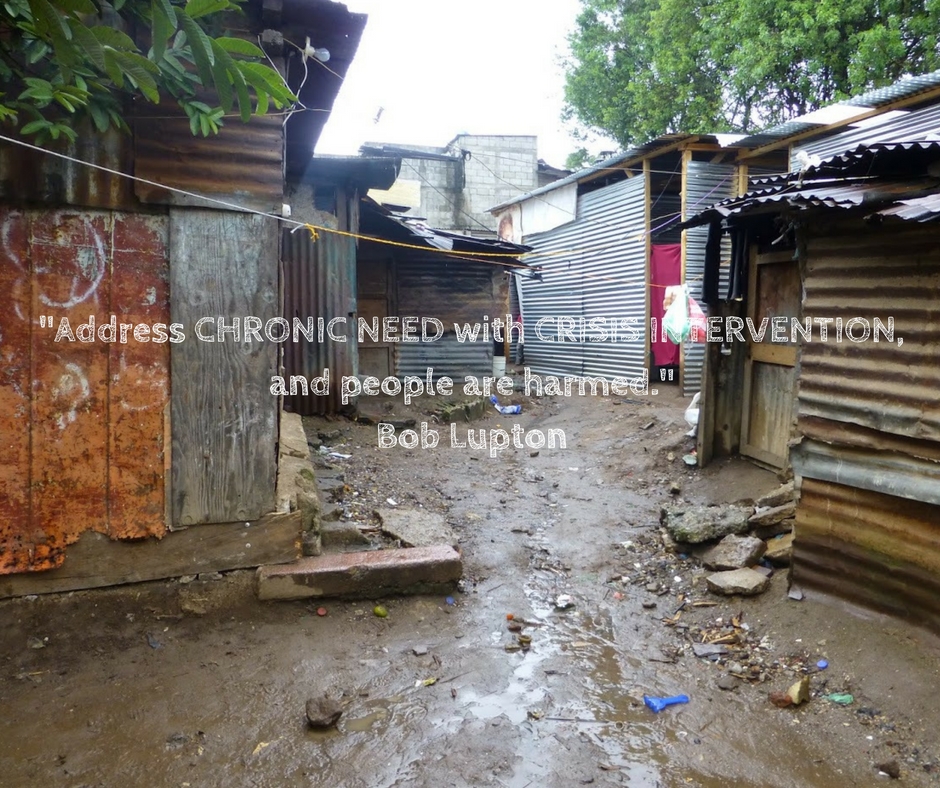
An important aspect of creating a frame for the conversation is creating a timeframe. Creating a goal with a specific timeframe often jolts people into focused action. This works with both chronic and crisis situations, but the approach can be different and in mission work or poverty alleviation it must be different to not be harmful.
Crisis and chronic poverty situations require different responses, either relief or development. Giving relief in a chronic situation can harm both giver and receiver.
Bob Lupton provides an important elaboration of this concept.
A CRISIS need demands RELIEF intervention. (Think: an earthquake, tsunami, famine, war. The goal is to ‘stop the bleeding.’)
A CHRONIC need requires DEVELOPMENT. (Think: rebuilding homes, re-starting businesses, rebuilding infrastructure. We have to strengthen capacity.)
Address a CRISIS need with a CRISIS intervention, and lives are saved. (Think: doctors and medical supplies to treat the wounded, food and water to feed the starving, tents to shelter the refugees…)
Address a CHRONIC need with CRISIS intervention, and people are harmed. (Think: dependency increases, work-ethic erodes, dignity diminishes.)
So how are people harmed when relief is applied in a chronic situation that calls for development? People are harmed because the self-internalized poverty messages we looked at in the previous post are reinforced in both giver (God-complex, savior) and receiver (worthless, hopeless, and destined to be poor). Over time this harmful pattern creates a culture of dependency. Lupton explains the progression of One-Way Giving (relief):
- Give once = appreciation
- Give twice = anticipation
- Give three times = expectation
- Give four times = entitlement
- Give five times = dependency
There are times that relief is the proper response, and sometimes relief is the way into relationship, but it must be done carefully with discernment. Often both givers and receivers become dependent on relief because it is easier, cleaner and less time consuming than life changing transformational relationships.
Because poverty exists in all of us, as we work to reconcile relationships with God, ourselves, others and all of creation, we are all working toward poverty alleviation. For this reason, we need to be aware of whether we are in a chronic or crisis situation and be careful to address our situation with the proper response.
 KATHY PIERBURG