As we step into the new year, I pray a blessing on you:
If you, as you reflect on the past year and look forward to the next, recognize an area of stuckness, please reach out to me. Let’s talk about potential coaching opportunities.
Coaching, Consulting, Missions and Outreach
As we step into the new year, I pray a blessing on you:
If you, as you reflect on the past year and look forward to the next, recognize an area of stuckness, please reach out to me. Let’s talk about potential coaching opportunities.

On this Christmas day in the year of 2020, I pray that you rest and rejoice that Jesus did not hold equality with God and comfort in heaven above His desire for relationship with us and restoration of the world.
Peace and Joy to you and yours!
“Your attitude should be the same as that of Christ Jesus:
Who, being in the very nature God, did not consider equality with God something to be grasped,
But made himself nothing, taking the very nature of a servant, being made in human likeness.
And being found in appearance as a man, he humbled himself and became obedient to death – even death on a cross!”
Philippians 2: 5-8

The final stronghold that keeps us from abundance is a lack of trust from an actual or perceived betrayal. Before you think I do not have conflict with anyone, the lack of trust from what feels like betrayal can be rooted in a feeling of self-judgement or even disappointment (in God) that things did not work out the way you wanted. Relational conflict or being disappointed in our past actions, results, or circumstances can create a feeling of betrayal and lack of trust. Bitterness grows from the feeling of betrayal and unforgiveness. The only answer is forgiveness.
Matthew 18: 21-22 says, “Then Peter came to Jesus and asked, ‘LORD, how many times shall I forgive my brother when he sins against me? Up to seven times?’ Jesus answered, ‘I tell you, not seven times, but seventy-seven time.’”
Essentially, Jesus is telling us to lose track of how many times we forgive. He warns us not to get stuck in unforgiveness.
A common anecdote about unforgiveness is drinking poison and expecting the other person to die. I like a different picture… When we are stuck in the bitterness of actual and perceived betrayal, it is like we are standing on a chair and cannot get down. We can see all kinds of things (true and good things) from the chair, but we cannot move because we are trapped on a chair. When bitterness is a stronghold, the chair becomes the place where we operate from. We are stuck and forward progress is stopped.
We hold back when we are bitter. Forgiveness moves us to a place of abundance because we are able to give ourselves again. Forgiveness is not about the other person, but about allowing us to move into the abundance of possibility and the future. It does not necessarily mean reconciliation, but it allows us to move from that place, so we do not operate from the place of bitterness.
Is there someone you need to forgive? Yourself? God?
I hope you take the time this holiday season to reflect on the opportunity for abundance in your life. Where are you stuck in strongholds of scarcity? What steps can you take right now to move toward the abundance God has designed for your life?

Another common scarcity mindset involves time. We really love being busy. A packed schedule gives the illusion of value in our culture. In all honesty, we worship being busy. We worship the scarcity mindset of not enough time because it feeds our identity of being needed. This mindset quickly becomes a stronghold that is not easily broken as we believe our identity is rooted in what we do.
When we do not have a proper perspective of time, we limit the work of God in our life. Our view of time and our work is distorted, and we limit ourselves into scarcity.
How do we break the stronghold of scarcity of time? What does God ask of us to break this stronghold?
The Old Testament consistently calls us to give 1 day every week or keep the Sabbath to keep time in proper perspective. God asks even more of our time than of our money. Resting on the Sabbath asks us to give 1/7th or 14% of our time. We see in Isaiah 58:13-14 blessing comes from giving our time.
“If you keep your feet from breaking the Sabbath and from doing as you please on my holy day, if you call the Sabbath a delight and the LORD’s holy day honorable, and if you honor it by not going your own way and not doing as you please or speaking idle words, then you will find your joy in the LORD, and I will cause you to ride on the heights of the land and to feast on the inheritance of your father Jacob.”
Keeping the Sabbath disrupts our relationship with time and breaks through the stronghold of scarcity of time. God asks more time than money because your relationship with time, your mindset of time will keep you stuck. When you have an abundance mindset, nurtured through the practice of Sabbath, you have freedom to live into your Kingdom purpose.
Do you see the abundance that comes from keeping the Sabbath?
Joy, riding on heights, and feasting. These are words of abundance. God explains this is the result of keeping the Sabbath.
What do you do on a Sabbath? What does rest look like? Ultimately, resting is different for each of us, but it starts with remembering who you are and how you were created. To implement the practice of Sabbath, we need to disrupt how we spend our time one day a week. Maybe it is a break from email, text or social media. Maybe it is time in nature or with friends and family.
I highly suggest it begins and ends with prayer and scripture pointing you back to your creator and reflecting on the gifts and talents He specifically created you with.
Sabbath is a practice and a discipline. It may take time to figure out exactly how it works for you, and it may change throughout different seasons. However, over time you will experience that the time of reflection and recalibration will impact the rest of time, leading to abundance where there was once scarcity.

For this month, I want to reflect on the abundance vs. scarcity mindset and God’s plan for you to break three common strongholds that keep people from living life to the full. The first one has to do with the mindset of not enough money. Lack of money is a common scarcity mindset, and one that I do not disregard, however, most often the mindset of scarcity of finances is a mindset that limits our potential, thus becoming a stronghold.
How often have you said or heard someone say, if only I had the money…
While we are to be wise with our resources, we can limit the work of God in our lives if we view finances through a scarcity mindset. The most powerful way to shift to an abundance mindset is through giving. The Old Testament of the Bible shows God’s desire for us to give 10% of our income to His work. (The New Testament asks even more – if you have 2 coats, give 1 OR sell everything you own and give to the poor- but we will focus on the 10% for now.)
I am not a prosperity gospel believer (for many reasons) because sometimes we do not see the blessings in the way we expect. I do believe abundance comes from a generous heart. The Bible consistently warns us not to test the LORD, but in Malachi 3: 10, we are told to test God by giving 10%.
“’Bring the whole tithe into the storehouse, that there may be food in my house. Test me in this,’ says the LORD Almighty, ‘and see if I will not throw open the floodgates of heaven and pour out so much blessing that you will not have room enough for it.’”
What if the blessing that we will not have room for is the abundance mindset?
What if this blessing is the freedom to break the stronghold of scarcity?
What if this blessing is to move forward in faith and hope into our Kingdom purpose?
Giving 10% of our income breaks the stronghold of not enough and opens the door to living life to the full. I have known people who have gotten creative with making this happen – finding additional work, saving in new ways, stopping an expensive habit. Ultimately, if you are struggling with the stronghold of scarcity of money, you probably know what needs to happen to unlock the storehouse of abundance.
Generosity is easy in December. We have our attention turned toward gifts and love and joy. Perhaps this is the month to start small. Choose a charity or church mission to donate to. Collect toys, clothes or food to donate to a local effort in your community. Start now, when it seems to come naturally, and make a plan to carry it into the next year.
How can you move toward giving 10% of your income? What is your next step toward the mindset of abundance?
The Bible tells us that humans are created in the image of God. We know this from Genesis1:27, which The Amplified Bible translates as, “so God created man in His own image, in the image and likeness of God He created him; male and female He created them.” While that is straightforward, it is also easy to see that God is creative, just look at His creation from the earth to the intricacies of the human body. So, if humans are created in the image of God and God is creative, then we are created creative. Every one of us is created creative.
The implications of this idea are profound and empowering for all people. If every person, including those in material poverty, are created creative, then each of us have been created with unique gifts, skills, and talents to impact our lives and God’s Kingdom around us. While there are many challenges in communities of material poverty, we must believe that the people who live there often have the creative potential to positively impact their community.
Creative problem solving does not rest only on those not living in material poverty. We need to guard the dignity and creative potential of everyone we serve, being aware of our tendency to make assumptions of needs or lacks and guarding against damaging the creativity and agency of those we are trying to help.
“In true community we are windows constantly offering each other new views on the mystery of God’s presence in our lives”
Henri Nouwen
When we realize we are created in the image of God, we can see there are aspects of His character in each person. The creativity of God allows for unique combinations of His characteristics, and in community with others we can experience those unique combinations.
“When I immerse myself in the lives of others whose life’s story reflect distinct aspects of God’s grace, power, wisdom, and holiness I come to know more of God. God does not change, but I know more of Him than I could have comprehended in isolation.”
Brad Hambrick
Community allows a unique intersection of knowing others, ourselves and God more as we interact and experience relationship. A community that embraces this truth sees value in each person and protects the ability of each to contribute in meaningful ways.

There are really two basic approaches to poverty alleviation. First is relief. Fikkert and Corbett define relief as the “urgent and temporary provision of emergency aid to reduce immediate suffering from a natural or man-made crisis. The key feature of relief is a provider-receiver dynamic in which the provider gives assistance-often material-to the receiver, who is largely incapable of helping himself at that time.” Relief should be applied in a crisis situation. Crisis counselors define a 6 week timeline for moving past the crisis. Beyond the 6 weeks, a situation becomes chronic.
The second approach toward poverty alleviation is development. Again, Fikkert and Corbett provide an excellent definition. Development is “a process of ongoing change that moves all the people involved-both the ‘helpers’ and the ‘helped’-closer to being in right relationship with God, self, others and the rest of creation. Development is not done to people or for people but with people. The key dynamic in development is promoting an empowering process in which all the people involved-both the ‘helpers’ and the ‘helped’ become more of what God created them to be.” So, development is an approach that allows for growth in all kinds of poverty, material and non-material poverty. Development becomes a platform for growth for all those involved. Development is what is needed in a chronic situation once the 6-week crisis period is over.
We need to encourage long term relationship over short term relief. In true development, both giver and receiver are growing to right relationships (poverty alleviation) with God, self, others and all of creation. It is through this type of long-term trusting relationship that we will see true life transformation, as both giver and receiver grow in their relationships with God, self, others and the rest of creation.
Long term relationships are especially needed right now. People have experienced layers of chaos and uncertainty over the last several months. Many are in need of relief due to legitimate crisis situations related to the pandemic and the resulting economic challenges, but we also need to be tapping into creativity to find a way into the next normal rather than remaining stuck in the cycle of relief.
Remember, everyone grows in development, which makes true development beneficial for all.
An important aspect of creating a frame for the conversation is creating a timeframe. Creating a goal with a specific timeframe often jolts people into focused action. This works with both chronic and crisis situations, but the approach can be different and in mission work or poverty alleviation it must be different to not be harmful.
Crisis and chronic poverty situations require different responses, either relief or development. Giving relief in a chronic situation can harm both giver and receiver.
Bob Lupton provides an important elaboration of this concept.
A CRISIS need demands RELIEF intervention. (Think: an earthquake, tsunami, famine, war. The goal is to ‘stop the bleeding.’)
A CHRONIC need requires DEVELOPMENT. (Think: rebuilding homes, re-starting businesses, rebuilding infrastructure. We have to strengthen capacity.)
Address a CRISIS need with a CRISIS intervention, and lives are saved. (Think: doctors and medical supplies to treat the wounded, food and water to feed the starving, tents to shelter the refugees…)
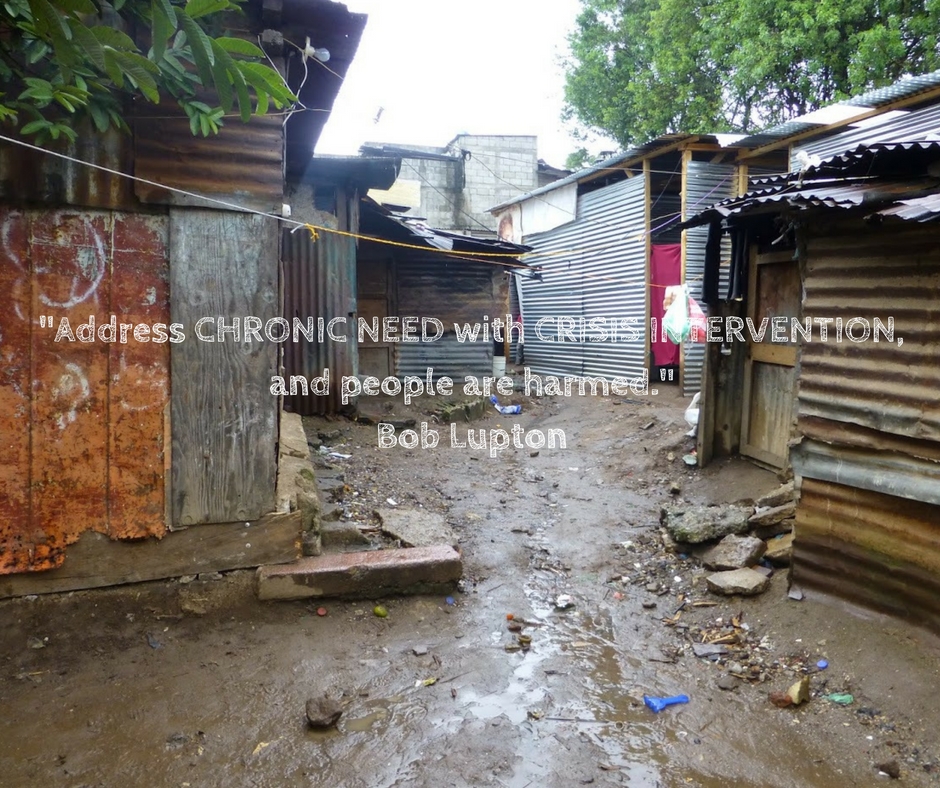
Address a CHRONIC need with CRISIS intervention, and people are harmed. (Think: dependency increases, work-ethic erodes, dignity diminishes.)
So how are people harmed when relief is applied in a chronic situation that calls for development? People are harmed because the self-internalized poverty messages we looked at in the previous post are reinforced in both giver (God-complex, savior) and receiver (worthless, hopeless, and destined to be poor). Over time this harmful pattern creates a culture of dependency. Lupton explains the progression of One-Way Giving (relief):
There are times that relief is the proper response, and sometimes relief is the way into relationship, but it must be done carefully with discernment. Often both givers and receivers become dependent on relief because it is easier, cleaner and less time consuming than life changing transformational relationships.
Because poverty exists in all of us, as we work to reconcile relationships with God, ourselves, others and all of creation, we are all working toward poverty alleviation. For this reason, we need to be aware of whether we are in a chronic or crisis situation and be careful to address our situation with the proper response.
As Director of Missions and Outreach for my church, I spend a good deal of time thinking about poverty and poverty alleviation work, which is ultimately the core of all mission activity. Poverty can be defined as broken relationships. Broken relationships with God, self, others, and creation look different for each of us, but we all have areas that need healing. I find missions and coaching work intersect as a vehicle to work toward the healing each of us needs.
Genesis 3 describes the original sin of Adam and Eve, from which all broken relationships originate. Brian Fikkert and Steve Corbett in When Helping Hurts: How to Alleviate Poverty Without Hurting the Poor … And Yourself explain the repercussions of this original sin,
The Genesis account records that all four of Adam and Eve’s relationships immediately became distorted: their relationship with God was damaged, as their intimacy with Him was replaced with fear, their relationship with self was marred, as Adam and Eve developed a sense of shame; their relationship with others was broken, as Adam quickly blamed Eve for their sin; and their relationship with the rest of creation became distorted, as God cursed the ground and the childbearing process.
Brian Fikkert and Steve Corbett
All these broken relationships are examples of poverty. This diagram provides a visual of the broken relationships which do exist in both the materially poor and the non-materially poor.

In this diagram, under the relationship with the rest of creation, you can see a poverty of stewardship that appears differently in materially poor and non-materially poor cultures. In a materially poor environment, you might see the generational cycle of fatalism – why even try, we will always be worthless, but in a non-materially poor environment, you might see the generational cycle of workaholism or overachieving.
Another critical connection is under poverty of being. Often those in poverty, like those living at the garbage dump in Guatemala City, already have a low self-esteem because of how their society views them. Combine that with a North American mindset, we often think we know best how to help people on a mission trip. Both of these poverty mindsets can be re-enforced, and damage done if a mission trip comes in, builds a house for the family, confirming the North Americans know how to do it and the Guatemalans do not.
A major aspect of what I do, is constantly reframing the way things have been approached in the past. This is where I see the intersection of missions and coaching. As mentioned last month, coaching provides an opportunity to reframe your mindset. An important step to combatting poverty of all kinds, whether physical, emotional, mental or spiritual, is changing your perspective and realizing the origin of our poverty. Perhaps your church or nonprofit is wanting to look at things from a different perspective. I would love to help, contact me to talk about options.

“We have come to believe that beautiful questions actually do reveal beautiful answers. If we Christians really believed that beautiful questions are far more important than well-crafted answers, our mission with people would be far more effective”
Joel Van Dyke and Kris Rocke
The most important job of a coach (or really any leader) is framing the conversation. Asking the right questions helps frame the conversation and chart a course forward. A simple frame is to create a 90 day goal. While a 90 day goal can focus on anything and most likely create momentum in multiple areas of life, a helpful question during our current discontinuous change environment is “What is most important, right now?”
Patrick Lencioni calls the answer to this question the thematic goal, and he explains, “the point here is that every organization, if it wants to create a sense of alignment and focus, must have a single top priority within a given period of time.” The thematic goal is one that is focused, specific, time bound and shared across the organization. The thematic goal can be seen as a rallying cry. A good way to frame the discussion of the thematic goal is,
“If we accomplish only one thing during the next x months, what would it be? In other words, what must be true x months from now for us to be able to look back and say with any credibility that we had a good period?”
Patrick Lencioni
The time frame for a thematic goal should be between three and twelve months. I suggest shorter time frames during this time of discontinuous change. The shorter goals allow for more learning and application of that learning into appropriate interventions. 90 day cycles allow for the iterative process of adaptive leadership.
Is it time to invest in yourself by hiring a coach? It has been a rough year, and challenges will continue (of one kind or another). Having a coach frame the conversation will free you up to get moving again. By focusing on what is important right now, you create intention and momentum. Let me know if you are ready to get some coaching and make progress on your goals.

 KATHY PIERBURG