START SMALL, BUT START

The foundational value of my work is Insight + Action = Transformation. Insight gives the illusion of transformation, and the only way to combat this illusion is with action. The last few weeks, I have posted about the challenges of our time, the discontinuous change, the need for adaptive leadership, and the proper perspective for adaptive leaders. Now, it is time to act out of all that insight.

We need to start small but start. Another word for starting small is prototyping. It is time to take what we have learned about our “New Normal” and start experimenting. In the Praxis Article, “Strategies for Winter,” the authors encourage, “it is a time to prototype everything (programs, products, services, pricing, delivery modes, partnerships, team structures, messages) that both help you now and provide real data and direction for initiatives that have considerable long-term value for those you partner with and serve.”

The process of prototyping is adaptive leadership. The approach to adaptive leadership is a cycle of learning and doing (insight and action). Because it is a cycle, it is never finished or completed, but is continual.
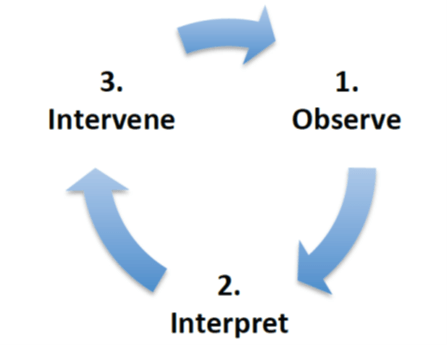
Adaptive leadership is iterative. Each step builds on the next and continues to refine and improve the process. Heifetz and Linksy explain:

  • Observing events and patterns around you.
  • Interpreting what you are observing—developing multiple hypotheses about what is really going on.
  • Designing interventions based on the observations and interpretations to address the adaptive challenge you have identified.

Adaptive leaders understand adaptive challenges cannot be solved quickly. They also know there will be more than one right way to solve the challenges, so they value learning through the process. This is why it is so important to start and to start small. The process of starting allows us to test and learn and iterate our ideas into more and more effective interventions.

Are you ready to start? Are you ready to move into the action phase? I am here to help. Moving from ideas to action is always an important aspect of coaching, I would love to support you through the process.
WHERE DOES OUR HOPE COME FROM?

            During times of discontinuous change, like we are experiencing right now, human nature is to look to leadership to solve our problems. This is nothing new. Soong- Chan Rah, in Prophetic Lament, explains this is what happened when Israel was taken into captivity by Babylon. The captive Israelites looked for leaders to give them easy answers to fix the challenges they were facing. He goes on to explain that the leaders with easy answers are the false prophets that Jeremiah warns against.  

There are many parallels to what we are experiencing today. While we have not been taken into captivity by a rival nation, we are facing uncertainty and struggle, and most of us are looking for the easy way out. Human nature is to look for the path of least resistance. While, Rah explores the Jewish nation in exile, he connects to similar trends in North American Christianity. “It is the same message that so many American Christians want to hear: they are still in control, there is no need for judgment, and there is no suffering. But easy answers that offer false hope are not solutions.”

Now, in the middle of a contentious election season, I can’t help but be concerned by the hope and fear on both sides of the political divide. It seems that people are fixated on either the hope of what their candidate can do to fix the United States or fixated on the fear of how the other side is going to destroy the country. Focusing on the individuals with such intensity opens the door to believing the false hopes of false prophets.

None of the candidates will save us or fix us, and we will be disappointed if we place our hopes in them.

Leonce Crump in Renovate explains who we can place our trust in. He writes, “the alternative then is not only to trust the promises of God but to continually acknowledge our longing and know in whom to place our expectation of its fulfillment. The only leader adequate to usher in the future era of holistic healing of God’ creation and human flourishing is God Himself.”

God is our only hope. His coming Kingdom is when we will realize the fulfillment of all His promises and our longings. In the meantime, though, leaders have the opportunity of working towards the Kingdom today. If leaders can recognize where the true power of flourishing is rooted, they can move into the adaptive leadership that is needed on earth until the fulfillment of God’s promises.

WHY ISN’T THIS WORKING?

There are two kinds of problems that we face in leadership and our organizations, and recognizing the difference determines our effectiveness in addressing the challenge.

First are technical problems, which while complicated, can be solved with existing knowledge and skills. Adaptive challenges, on the other hand, require new learning, creativity, and adjusted ways of operating.

A description from the work of Ronald Heifetz and Marty Linsky describe adaptive challenges “as swamp issues— tangled, complex problems composed of multiple systems that resist technical analysis and thus stand in contrast to the high, hard ground issues that are easier to address but where less is at stake for the organization or the society.”

Does this sound like the discontinuous change we are experiencing in all aspects of life right now?

As mentioned in last week’s post, we are in a time of discontinuous change. Effective response to discontinuous change demands adaptive leadership. Adaptive leadership is what allowed Lewis and Clark, in the analogy of Canoeing the Mountains, to adapt to the new obstacles yet still succeed. Adaptive leadership is what is needed today.

The problems we are facing today are anything but straightforward and cannot be solved with what we already know. However, many of us are attempting to deal with them using our existing knowledge and skills. It is not working is it?

The problems we are facing, whether it is our response to the COVID-19 pandemic, racial injustice, social unrest, political division, or economic turmoil, require different thinking and different leadership. Our organizations are facing an unknown future, much like Lewis and Clark looking over the Rocky Mountains. We cannot only use what we know and what we know to do to launch us into the next phase. We must tap into adaptive leadership.

Adaptive leaders are open to learning, willing to experiment, and inclusive of diverse perspectives. They also need support and encouragement because the journey to address adaptive challenges is long and difficult.

Is your organization feeling the pain of the current environment and struggling to get traction with the tried and true skills of the past?

Are you, as a leader, recognizing something needs to change, but are not able to name exactly what that change is?

Maybe it is time for some coaching or consulting? We are in an unprecedented time. We are in a time crying out for adaptive leadership. While I cannot tell you the solution to your challenge, I will walk with you and your organization through the process of engaging adaptive strategies. I believe the investment of time will strengthen your organization and prepare it for whatever is the next wave of uncertainty. Reach out if you would like to have a conversation about options.

ARE YOU CANOEING THE MOUNTAINS?

Change is Stressful

Does everything feel stressful right now? Does it feel like nothing is working the way it used to? Are your skills and experience not helping as they have in the past?

We are in a time of discontinuous change. We can look at 2020 and recognize we have experienced change and uncertainty at higher than normal levels, but this year is truly just the tip of the iceberg. We have been experiencing discontinuous change for many years.

Alan Roxburgh and Fred Romanuk give a helpful explanation of continuous change and discontinuous change. They write, “continuous change develops out of what has gone before and therefore can be expected, anticipated, and managed… We have a stock of experiences and resources to address this developmental change.” They use the example of growing children; we know in general what to expect, and can learn from those who have gone before, as children develop through the stages of childhood, adolescence, and adulthood.

Discontinuous change is very different. It is “disruptive and unanticipated; it creates situations that challenge our assumptions. The skills we have learned aren’t helpful in this kind of change.”

Tod Bolsinger provides a powerful metaphor for discontinuous change in his book Canoeing the Mountains. He describes the challenges facing Lewis and Clark’s expedition as a way of highlighting the challenges facing leaders today. Lewis and Clark planned to travel by river from the Mississippi River to the Pacific Ocean. They expected to use what they knew, water travel, to cover ground they did not know. What a surprise it was for them to face the Rocky Mountains instead of rivers. The same holds true of leaders today.

We expected to use the knowledge and skills already cultivated and in use to carry us to the goal, but just as Lewis and Clark could not use their canoes to get over the Rocky Mountains, we cannot use our existing toolkit to forge a path into an unknown future. 

We have heard a lot in 2020 about the new normal or the next normal. The truth of discontinuous change is that we will not return to life as we knew it. So, the question becomes how do we evolve and thrive in the midst of discontinuous change? We will need new skills and a new mindset.

Is this feeling real for you right now? I’d love to talk through coaching options for leaders and organizations facing the real struggle of trying to adapt to our changing environment. Let me know if I can help.

HUMBLE LEADERSHIP

We are in need of a new kind of leadership. A leadership that listens before speaking; a leadership that seeks to understand before solving; a leadership that puts other before themselves. This type of leadership is countercultural and quite opposite of what we are seeing right now. But it is this leadership that Jesus modeled for us. Paul describes it in Philippians 2:3-8:

Do nothing out of selfish ambition or vain conceit. Rather, in humility value others above yourselves, not looking to your own interests but each of you to the interests of the others. In your relationships with one another, have the same mindset as Christ Jesus: 6 Who, being in very nature God,
   did not consider equality with God something to be used to his own advantage;
7  rather, he made himself nothing
    by taking the very nature of a servant,
    being made in human likeness.
And being found in appearance as a man,
    he humbled himself
    by becoming obedient to death—
        even death on a cross!

We can use this scripture to model our behavior after the example of Jesus, but sometimes it is a process to allow the Holy Spirit to have access to our hearts and minds to cultivate true humility. This week in My Utmost for His Highest, Oswald Chambers encourages believers to be open to the people or circumstances the Holy Spirit is using to refine and create humility.

Yet God can never make us into wine if we object to the fingers He chooses to use to crush us. We say, “If God would only use His own fingers, and make me broken bread and poured-out wine in a special way, then I wouldn’t object!” But when He uses someone we dislike, or some set of circumstances to which we said we would never submit, to crush us, then we object. Yet we must never try to choose the place of our own martyrdom. If we are ever going to be made into wine, we will have to be crushed—you cannot drink grapes. Grapes become wine only when they have been squeezed.

I wonder what finger and thumb God has been using to squeeze you? Have you been as hard as a marble and escaped? If you are not ripe yet, and if God had squeezed you anyway, the wine produced would have been remarkably bitter. To be a holy person means that the elements of our natural life experience the very presence of God as they are providentially broken in His service. We have to be placed into God and brought into agreement with Him before we can be broken bread in His hands. Stay right with God and let Him do as He likes, and you will find that He is producing the kind of bread and wine that will benefit His other children.

Take some time with God soon. Ask Him who and what He is using to mold you. Breath through it, because you might be shocked, then work with Him. How is He working humility into your heart, mind, and spirit? If you allow His work, you will be ready to serve others through the humble leadership He is growing in you.

RHYTHMS OF THE COMMUNITY

Photo by VisionPic .net on Pexels.com

As you look for ways to connect with neighbors, it is helpful to watch for the rhythms of the community and to be intentional for the opportunities that are presented.

Hugh Halter and Matt Smay explain, “the habit of living among, means participating in the natural activities of the culture around you.” There are two ways of approaching the rhythms of your community, and it is helpful to have both on your radar so that you can engage appropriately. First, you can be aware and look for the general rhythms of life. Ash Barker gives a wonderful list to highlight the general rhythms of life in your awareness. He encourages intentional connection with your community through:

  • Celebrate together: times of birthday parties, wedding, and so on.
  • Commiserate together: times of loss, death, and grief.
  • Have common meals together: times of fellowship around a meal.
  • Resolve conflict together: times of clarity and learning to live together.
  • Be there in times of change together: times of getting to know new neighbors and passages of life changes.
  • Be there in times of crisis together: times of being out of control and banding together.
  • Share common goods together: times of sharing what we have with others who do not have.
  • Share common prayers together: time to pray for people as a normal part of life.
  • Share a common identity from living in a common place together: time to see each neighbor as part of the same village.
  • Affirm community contributions: times to let leaders lead in their own areas of responsibility and giftedness and celebrate these contributions.

As you start to see the points of potential connection and learn more about your community through listening and learning to God and the community (see posts on 9/4 and 9/11), you can start to identify the rhythms specific to where you live. I like to layer what I know about my neighborhood over Barker’s list. For example,

  • In the Fall – We celebrate the start of school; we gather around football games, and we welcome our neighbors and those outside the neighborhood to a night of “trick or treating” at Halloween.
  • In the Winter – In between the days of staying warm inside, we celebrate the holidays of Thanksgiving, Christmas, and New Year’s through decorations and gatherings, and we play in the snow with our families.
  • In the Spring – We emerge from winter by spending more time outside, you will see my neighbors caring for their yards, playing with their families, having garage sales, and celebrating graduations and the end of school year.
  • In the Summer – We gather at the pool, have barbeque get togethers, throw block parties, and celebrate the 4th of July with a bike parade and fireworks.

Of course, with the Coronavirus Pandemic, so many of our normal ways of interacting have changed. However, the rhythms are still there, and the connection is needed more than ever. We have to be even more intentional and creative in how we relate.

What has come to mind for your community? How do you plan to engage in the rhythms that already exist or create new rhythms? Share your thoughts so we can learn from each other.

INTENTIONAL NEIGHBORING

Photo by Craig Adderley on Pexels.com

Who are the people in my neighborhood?

The old Sesame Street song points to a different time in our society. One in which everyone knew everyone. For a number of reasons, people do not know and are not as connected to each other as they used to be. Is this true for you? Do you know your neighbors? What are their names? What are their talents and dreams? How do they struggle?

John McKnight and Peter Block explain, “in too many cases, we are disconnected from our neighbors and isolated from our communities…. But our communities are abundant with the resources we need for the future.” Due to current events and our dependence on social media, we are actually more disconnected from our neighbors than ever before, and we do not know enough about them to know how you could help each other. You might be agreeing with the ideal of this, but not know how to start. You might be even asking what the expert in the law asked Jesus.

“And who is my neighbor?” ~ Luke 10:29

Jesus answers this question with the now famous story of the Good Samaritan. Often, this parable is used to encourage loving and serving people who are very different from us, and that is definitely true and a powerful exhortation. Today, however, I would like to encourage you to love and serve your actual neighbors, who may or may not be similar to you. But in a world of separation and disconnection, how are we supposed to love our neighbors?

It takes intentionality. It takes presence. It takes time. It takes authenticity.

Intentional Neighboring is a choice to know and care for our neighbors and neighborhoods. It is a journey of walking in both blessing and struggle. McKnight and Block write, “we discover the abundance of our community not only when our gifts are acknowledged, but also when our sorrows are revealed.” Being real is sharing our hopes and dreams as well as our hurts and struggles. This level of authenticity does not happen overnight, but each small step towards people, looking for connection and relationship does make a difference. Soon enough, you are enveloped in meaningful relationships with the people who live all around you.

Gerald Sittser explains, “give God an inch and he takes a mile, though we hardly ever notice because we are actually walking that mile, one step at a time. We take one small risk; years later we look back and marvel at what has happened as a result.”

Intentional neighboring can feel risky at times, but over time the connections and potential of the relationships will provide a powerful testimony of loving our neighbors as Jesus commanded.

LISTEN AND LEARN

Photo by Ketut Subiyanto on Pexels.com

“My dear brothers and sisters, take note of this: Everyone should be quick to listen, slow to speak and slow to become angry”

~James 1:19

After a time of regular prayer walks, you will start to see your community as God sees it. He may start speaking to you about redeemed and restored people and places. You have started your process of community engagement by listening and learning from God. But, before you get too far down the path of determining the next steps, stop and seek out the people in the community to listen and learn from them.

“Before Jesus preached his first sermon, he spent thirty years listening to the world he loved so much… If the Word honors the world by listening intently to its pain, hopes, and fears, perhaps we would do well to spend the majority of our time listening to those we serve”

Joel Van Dyke and Kris Rocke

Often, individuals, churches, and ministries approach communities with a plan or project to serve. Later, the projects tend to fail to produce fruit. Why is this? The answer is directly tied to how much the community is involved in creating and implementing the plan. Listening and learning from the community members are crucial to bearing fruit. The step of listening to and learning from can take a long time, but the relationships built are foundational to any good work to come.

I can walk you or your church through a process of exegeting your community.

Exegeting is a fancy word for interpreting. Often exegesis is used in relation to scripture. According to the Anchor Bible Dictionary, “exegesis is the process of careful, analytical study of biblical passages undertaken in order to produce useful interpretations of those passages.” You can apply exegesis to understanding your community through careful and analytical study leading to useful interpretations. Exegesis of scripture leads to new ways of living; exegesis of the community also leads to new ways of living. There are four approaches to exegeting your community:  Inspirational, Informational, Incarnational, and Involvement. While the steps are simple, the process can be as in depth as you would like and will be more meaningful as you invest the time to truly learn and dig into what God is doing.

Would it be helpful to listen and learn more about your community? To explore and interpret it from these different perspectives?

Especially in this time of change and uncertainty, could the journey of exegeting your community benefit your church or ministry? I am here to help and guide you on the journey to explore what God is already doing and how you can join Him in building His Kingdom. Be in touch so we can set up a time to talk about this opportunity.

PRAYER WALKS

And what does the Lord require of you? To act justly and to love mercy and to walk humbly with your God. ~ Micah 6:8

One thing is for sure, no matter how you have been living in the midst of the pandemic, people are spending more time close to home. Extended time in our homes and neighborhoods invites us to explore opportunities to connect or improve our communities. We have seen the increase of home improvement projects as people focus on their homes and families, and that is great! But we can also use this time to turn our focus outward and look at the community surrounding us. An amazing place to start is to go on a prayer walk.

What is a prayer walk? What do you do on a prayer walk?

Prayer walks are very simple. Walk Humbly with Your God. As you walk through your neighborhood or community, ask the Holy Spirit to guide you in what to pray as you walk. Pay attention to what the Spirit draws your attention to. What are the physical things you see or do not see? Who are the people you notice? Where are the activity hubs? When are the quiet times? When are the busy times? Two of my favorite questions to pray through as I walk is how can I see the kingdom of God now, and how would the neighborhood change as the kingdom continues to expand?

Prayer walks can be a one-time event or a regularly occurring event, but you will learn more about your community if you walk at varying times of day. As you add prayer walks to your routine, you will begin to recognize the key people, places, and times of importance for your community. God will start to show you where to focus; His spirit will reveal where He is already working and preparing the ground for His Kingdom to take root and start to grow. Where He is working is where you should turn your attention. Prayer is the foundation for all meaningful work, and it is essential to integrate in all community care and connection.

Will you start to prayer walk in your community? Let me know how it goes. I would love to hear what God reveals about your community!

WHAT IS THE WAY FORWARD?

In March 2020, when the realities of COVID-19 were beginning to sink in, Praxis Labs wrote two articles framing the stages of COVID-19 as blizzard, winter, and ice age (Links to the articles are at the bottom). Here is how they defined the stages:

Blizzard: You can’t go out — zero visibility and hostile conditions. Need to shelter.

Winter: You can go out, but not for long. Wear protective clothing and check the forecast for storms. Need to survive.

Ice Age: Things don’t grow the way they used to — but we’re finding new ways to live and even to thrive. Need to adapt and rebuild.

Have you seen the shifts in thinking as we have moved through the last 5-6 months? I have. We definitely sheltered and weathered the storm in March and April. May, June, and July brought the longer season of winter, learning to survive in the new normal. Now in August and September, as schools head back and businesses are pushing for a return to normalcy, we are recognizing that there need to be new ways of engaging and interacting. We are looking for a way to navigate and thrive in the ice age. To adapt and rebuild in the new realities of the COVID-19 ice age, we need creativity and vision.

It is time to move past frozen toward new strategies and ideas.

It can be scary to do this, but it is necessary now. Before you can jump into the unknown, it is helpful to remember who you are and why you do what you do. What you do might be needing creative new ideas to pivot, but I would guess your core will most likely stay the same. Coaching and consulting can help you rediscover your core passion and purpose and design the next steps to take in this constantly changing world. Both individuals and organizations are needing fresh vision right now. Do you need personal coaching, organizational coaching, a little of both? Have you gotten frozen in the blizzard or winter stages? Are you ready to venture into the ice age? I’d love to help you find your way forward.

Praxis Labs Articles:

https://journal.praxislabs.org/leading-beyond-the-blizzard-why-every-organization-is-now-a-startup-b7f32fb278ff

https://journal.praxislabs.org/strategies-for-winter-redemptive-leadership-in-survival-times-f15a7791035a